How Jenson USA Improved Warehouse Performance and Reduced Costs
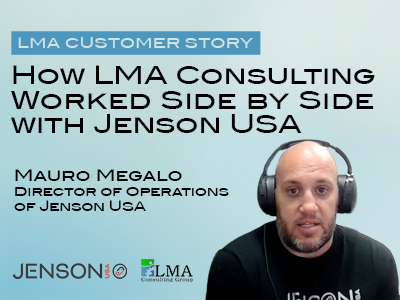
See how Jenson USA turned operational data into action to improve warehouse productivity, inventory visibility, and freight performance while building a scalable foundation for growth.



See how Jenson USA turned operational data into action to improve warehouse productivity, inventory visibility, and freight performance while building a scalable foundation for growth.
Explore LMA Consulting Group’s SIOP Resource Hub, including our flagship guide, Best of SIOP articles, FAQs, eBook, and practical implementation resources.
Learn how network strategy and optimization improve customer service, profitability, resilience, and scalable growth by aligning demand, capacity, sourcing, inventory, and distribution.
Learn why successful business transformation depends on leadership, process design, and technology enablement—not just project management or software implementation.
Learn how order management and commercial integration connect customer demand with operations to improve service, scalability, and predictable revenue.
Track the five essential SIOP metrics that improve forecast accuracy, customer service, inventory, capacity, and profitability to drive predictable growth.
Manufacturing is gaining momentum, creating significant opportunities for companies prepared to scale. Learn how to strengthen demand planning, assess end-to-end capacity, leverage technology strategically, and position your business for profitable growth.
Tariffs have become a long-term reality for manufacturers and supply chain leaders. This briefing recaps the key trade policy milestones, explains where U.S. tariffs stand today, examines the latest developments with China, and outlines practical strategies to reduce risk, improve resilience, and position for profitable growth.
Global supply chains are being rebuilt. Learn why FedEx CEO Raj Subramaniam believes AI, supply chain reconfiguration, and end-to-end transformation will define the next generation of manufacturing success—and what leaders should prioritize today.
The U.S. semiconductor industry is rebuilding more than fabrication capacity. Learn why end-to-end supply chain resilience, strategic supplier partnerships, and SIOP are becoming competitive advantages as manufacturers strengthen networks to support AI growth and reduce supply chain risk.